Tuesday, April 4, 2017

We're On a Roll

by Connie Cortright

How many times in a day do we use common paper products without thinking about them- toilet paper, paper towels, kleenex, etc. Who invented these products? When did they come on the market? The stories can be interesting even though the items are very ho-hum.

How about paper toweling? This story goes back into the late 1800s with the Scott Paper Company, founded in Philadelphia. Two brothers, E. Irvin and Clarence Scott, began to mass produce a new product for consumers - toilet paper. By the 1890s they were marketing toilet paper as a more hygienic way to deal with a universal issue.

In 1907 the head of the company Arthur Scott had a huge problem on his hands. His suppliers sent him a whole train car full of rolled paper manufactured incorrectly for toilet tissue. The paper was made too thick to be used for its intended use. Mr. Scott had a choice, either find a new way to use the thicker paper or waste all the money used to purchase the car load of unusable paper.

He heard of a teacher who was concerned about her children having so many colds in her classroom. She gave each student a soft piece of paper to use to wipe their hands instead of the common cloth roller towel by the sink. When each child used his/her own towel, the amount of illness in the room went down dramatically-an idea that is certainly known to all of us today, don't share germs.

Mr. Scott combined her idea with his car load of unusable paper and made a new product. He divided the thicker paper into smaller towel-size squares and called them Sani-Towels. He marketed them for use in public washrooms in schools, restaurants, and railroad stations.

 What does that have to do with this website since we talk about the 20s and 30s? By the 1920s these individual square disposable paper towels were common place in public restrooms, but they weren't available to the general public yet. They were only for commercial use sold by wholesale companies.
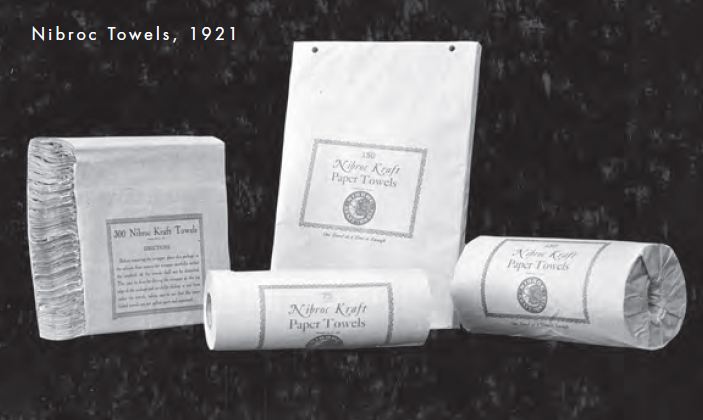
Courtesy of Wikicommons
In 1931, the Scott Company introduced these paper towels for use in the kitchen. They were manufactured on long rolls with perforations between the sheets. Thus a new product was now found on grocery shelves. Since then they haven't changed much except for absorbency and size of the sheets.

I've very glad that Mr. Scott found himself faced with a car load of the wrong type of paper. I couldn't imagine living in my kitchen without having paper towels inches away when I cause disasters on my kitchen counters. Just ask my husband!

 Information taken from Paper Towel History - Invention of Paper Towels

Tuesday, March 28, 2017

The Tax Man Cometh

by Connie Cortright

It's spring! when a young man's heart turns to thoughts of...TAXES!  I thought I'd cheer you up by  describing what Federal Income taxes were like in 1930.

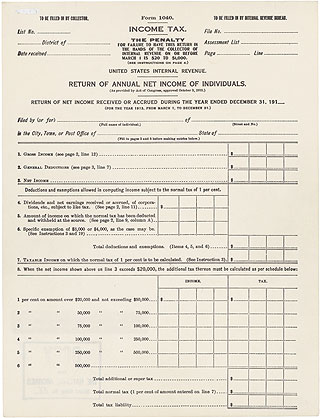
Income taxes were started in 1913, so in the 30s people dreaded tax day as much as we do. However, their tax day occurred on March 15 instead of April 15, and it probably wasn't as complex as ours.

The income tax forms back then were written on one or two pages. The second page was dedicated to  Schedules A, B, C, D, E, and F. Oh, for the good old days! The accompanying instructions were written on two pages, also. They probably didn't have to pay a tax pro to help fill out the confusing forms back then.

Since this was before the time of social security, no social security numbers were on the tax forms.  The income total did include other sources of income, such as bank interest as our does today.

On the deductions side the taxpayer was able to deduct donations, insurance, and taxes paid. That was all declared on 3 lines. Pretty straight forward.

They were able to subtract personal exemptions of $1500 for a single person and $3500 for a head of a family plus $400 per child - much like our exemptions today.

All the information was written on the first page and totaled up. The taxes were then calculated and written on the bottom line. Probably didn't take them longer than an hour to complete.

Only about one in forty-four people in the US in 1930 paid taxes and the taxes on average were 5% of income. On a per capita basis, we paid only $10.00 in income tax per person during that year.

A married man making $4000 subtracted the $3500 personal exemptions and then paid taxes on the remaining $500, which came to $2.50 for the year. In today's dollar that would be income of $54,344 and taxes of $33.97. That's why the people with an income more than $5000 (today $67,930) were the only ones who had to file their taxes back then.

A married man making $10,000 paid about $50.00 in taxes. (today = $135,860 income paying $679 taxes) Any income over $100,000 could not exceed 20% tax rate back then.

Maybe we should contact our congressmen and tell them to bring back the tax forms from 1930. It would make our lives a lot easier!

Information from this blog was taken from "A Comparison of British and U.S. Income Taxes in 1930" published in The Literary Digest for May, 24, 1930.

Tuesday, March 21, 2017

Nautical Meets Naughty

by Connie Cortright

Last week we touched on the topic of Betty Boop, but there's an important aspect that wasn't mentioned. In 1933 Betty Boop introduced someone to the world of cartoons and made him famous. Popeye the Sailor Man appeared in a Betty Boop cartoon titled "Popeye the Sailor". (What an interesting title!!) It was sold as a Betty Boop cartoon, but she only had a small part in the feature. Max Fleischer produced both Betty Boop and Popeye and used the popularity of Betty Boop to get his next creation off the ground.

In the film Popeye takes his girlfriend Olive Oyl to the carnival where Betty Boop is on stage dancing a hula - in a grass skirt and lei (covering certain parts). Popeye ends up on stage dancing with Betty Boop while the evil Bluto kidnaps Olive and carries her off, tying her to the railroad tracks. (Sound familiar?) Popeye finally eats his spinach and saves Olive by stopping the train cold. If you'd like to see the feature take a look Popeye the Sailor and Betty Boop

Popeye became more popular than Betty Boop in the later 30s after Betty Boop changed her ways with the new federal laws (see last week's blog post). By 1938 Popeye was the most popular cartoon character, passing up Mickey Mouse and others. Besides Olive Oyl, this cartoon also introduced Swee'Pea and Wimpy (I'd gladly pay you Tuesday for a hamburger today).

The most important "character" to this cartoon was Popeye's ever present can of spinach. Whenever he was in trouble, out popped the can of spinach which he opened by squeezing it with his bare hands. Most often the can of spinach was gulped down in one bite - or even inhaled through his pipe to give him the strength to overcome the bad guys and win the day. Popeye's use of spinach boosted sales of the vegetable, and consumption of vegetables in general, among children in the 30s, 40s, and 50s. My brother-in-law (it's reported) carried a small can of spinach around in his pocket all the time - although it was never consumed. I guess we have to assume that he never encountered a bad guy and needed the extra power of spinach, then.

commons.wikimedia.org
Popeye was so famous that there are cities in our country that still celebrate this cartoon character. Crystal City, Texas has a statue of Popeye in front of city hall because it's a spinach-growing area of the country. Another statue resides in Chester, Illinois, the hometown of the creator of the cartoon. That city celebrates its "son" each year by holding a Popeye Picnic on the weekend of Labor Day. That might be something to check out next Labor Day.

Popeye cartoons were very common in the 1950s on television and many of us grew up on these shows. Popeye's nemesis was known then as Brutus instead of Bluto since the latter name was copyrighted and couldn't be used by King Features Syndicate who commissioned the cartoon series in the 60s. Many a cartoon was spent with Popeye fighting the Sea Hag and other goons which were an invention of the later cartoons.

Besides cartoons, Popeye appeared in comic strips, comic books, and even a radio show in the late 30s. During World War II the writers of the features wrote with WWII themes in mind. Popeye could be seen fighting the Nazis or Japanese soldiers during these years. He surely has adapted over the years to fit the changes in the world around him.

What do you remember most about Popeye cartoons?

Information taken from Popeye